
The US midterm election is less than two months away in early November, and given the geopolitical and macro-economic background they are taking place against, they could be particularly important.
The elections take place every 4 years midway through the Presidential term in office; there have been 59 such elections, so there is a considerable body of evidence to weigh in the hopes of discovering what the 6th election could mean for traders.
The data tell us that since 1931, the S&P 500 has averaged a +4.7% return in midterm years, which is around 50.0% of the +9.50% return the index posts on average in non-election years.
Looking back to the recent past in 2018 and 2022, the S&P 500 index fell sharply by -18.10% and -4.40%, respectively. Ominously, perhaps, these drops have been attributed to Federal Reserve rate hikes rather than specific political fallout.
Expectations of a September rate hike increased rapidly from 33.0% to 93.0%

Source: CME Fedwatch
What's interesting, however, is that post-election, the S&P 500 often performs strongly, with Q4 posting average gains of around +6.40%. And since 1970, the three months following the midterms have seen the index rise by an average of +6.50%. What’s more since 1962, in the 12 months following the election, the S&P 500 has never posted a negative return and has averaged a +16.33% gain.
What’s at stake in the Midterm election?
All 435 seats in the House of Representatives or Congress are up for reelection alongside 35 of the 100 seats in the upper house, also known as the Senate as well as 36 state Governorships. Even though President Trump has governed without much reference to either the Senate or the Congress a change of control in either or both could limit his actions in the second half of his four years term.
Senate seats to watch
Source CNN
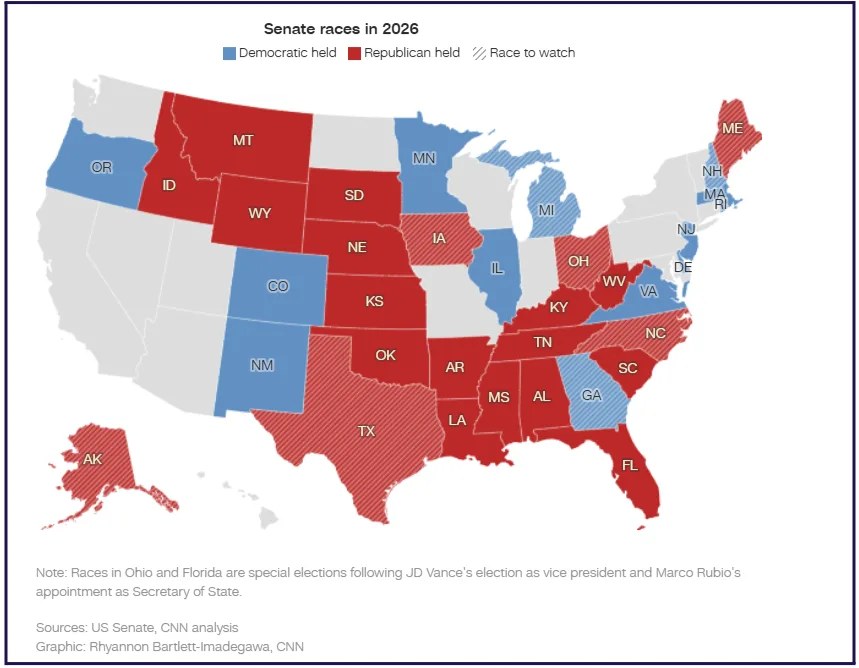
Republicans currently control the Senate 53 to 47 but the Republicans are defending more seats in November's polls, though many of these are in what would be considered strongholds..
The Republicans also have a majority in the Congress however it’s also a slim one at just 5 seats.
As with Presidential elections 2-years ago there are a number of so-called battleground states that could help determine the outcome particularly in the Senate they include Maine, Michigan, Georgia, North Carolina, Texas, Ohio, Alaska, and Iowa.
Low Approval
President Trump's approval ratings among US voters are low and possibly declining with a couple of polls showing him at 35.0% or lower of course it depends who you ask because Republican voters give him a 75.0% rating .
Prediction markets suggest that the Democrats will take control of the Congress by a convincing margin; its far less clear cut in the Senate the Democrats are still favourites but it's a much closer contest.
To add some extra spice there are a large number of Congressmen and women who are retiring this year meaning that there will be new names on the ballot sheet, which can create unexpected results.
Sector Performance
From a traders stand point the Healthcare sector has been the clear winner in mid term election years returning an average +10.70%, Energy averages +8.90%, whilst Industrials and Financials (two sectors which have reported earnings growth this year) tend to trade flat.
The rule of thumb is that the defensive sectors such as Consumer Staples, Healthcare, Communication Services, and Utilities tend to fare better in the run up to the election. And that cyclical sectors like Consumer Discretionary, Energy, Financials, Industrials, Technology, and Materials do better in the post election period.
But of course none of this is cast in stone and there is plenty of room for things to change over the next 6 weeks or so, especially around US foreign policy, inflation and interest rates.
The information provided does not constitute investment research. The material has not been prepared in accordance with the legal requirements designed to promote the independence of investment research and as such is to be considered to be a marketing communication.
All information has been prepared by ActivTrades (“AT”). The information does not contain a record of AT’s prices, or an offer of or solicitation for a transaction in any financial instrument. No representation or warranty is given as to the accuracy or completeness of this information.
Any material provided does not have regard to the specific investment objective and financial situation of any person who may receive it. Past performance is not a reliable indicator of future performance. AT provides an execution-only service. Consequently, any person acting on the information provided does so at their own risk. Forecasts are not guarantees. Rates may change. Political risk is unpredictable. Central bank actions may vary. Platforms’ tools do not guarantee success.