
If I said that there were similarities between trading and cooking you might think I was going mad. However, if you think about it for a moment, you will see where I'm coming from.
The best restaurants and chefs have the ability to create dishes that people enjoy and that make them want to return to eat again and again.
The secret to this is having a recipe, or recipes: which are a set of rules about ingredients, seasoning, cooking times, portion size and presentation, the return on investment, and the number of covers that need to be served, etc.
Success comes when the kitchen, and the front of house are consistently able to deliver, such that a meal I consume today will be just as good as one I eat in the restaurant in a month.
Consistency comes from following the recipe or rules with minimal deviation. If you do this well enough, you should have a full restaurant, and you may even get a chance at a Michelin star.
Success in trading is also about rule following, consistency, and not deviating from the recipe
Once you’ve created the recipe for success, the next phase is all about repetition, finding trading opportunities, identifying the setups that meet your criteria/risk-reward profile, etc., and actioning those trades, as they come into play.
Once a trade is running, you need to manage it, not only against your expectations and money management rules, but also against the market background, which, as we have seen recently, can be changeable to say the least.
Deaf to the mood music
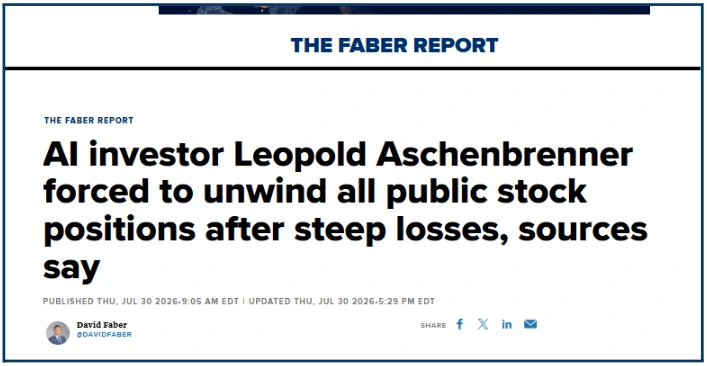
Not taking into account the changes in the market background can have dire consequences, just ask Leopold Aschenbrenner, the AI wunderkind turned hedge fund manager, who became famous overnight thanks to his bold directional bets on AI and adjacent sectors.
These leveraged plays created a +439.0% return for Aschenbrenner and his investors, but as we said in the last article, to maintain a premium rating, you need the mood music to keep playing and to be playing your tune. If that stops or changes, then you need to adapt your dance style pretty quickly or end up looking foolish.
That's what happened to Leopold Aschenbrenner's hedge fund Situational Awareness, named after a paper he wrote and published in June 2024, in which he set out his views about the future of AI over the next decade and by extension the investment opportunities this would create.
Sadly for Aschenbrenner the last thing he seems to have had in recent weeks was any sense of “ Situational Awareness”
At one point the fund was running as much as US $24.0 billion, money that was leveraged to increase its returns through high conviction trades in AI and AI adjacent stocks.
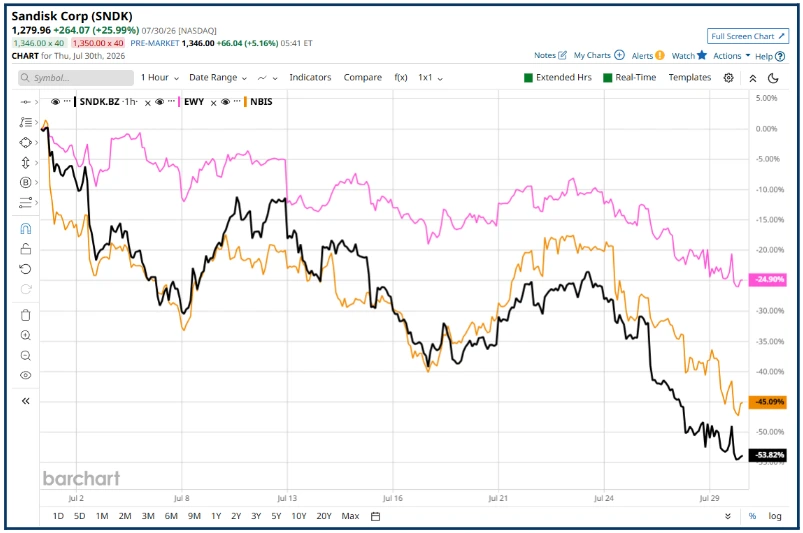
The chart below is a proxy for market sentiment towards AI stocks from the end of June to the 29th of July 2026. It contains memory maker Sandisk SNDK plotted against the MSCI South Korea ETF EWY and Neo data centre operator Nebius NBIS.
As I posted on trading discord earlier today:
“I don't think there is anything wrong with conviction, but as with anything, it needs to be grounded and attached to reality”
If you lose sight of the need to be grounded ,and can't hear the changes in the mood music (market sentiment) and you start believing that you are right and the markets are wrong.
Then you have succumbed to confirmation bias, loss aversion and a bubble mentality.
I say that because headlines like the ones below left traders in no doubt about the outcome of over leveraging in AI related stocks in the current market
A proxy for AI sentiment
The Kospi index, South Korea's equity benchmark is dominated by Samsung and SK Hynix (which account for more than 50.0% of the index weighting) are the first and second largest manufacturers of HBM memory chips in the world. Chips that are essential to the operation of AI data centres, which meant that the Korean stock market had become a punt on the future of AI.
In recent weeks Korean retail traders put billions into leveraged ETFs, and other products, betting on the continued suc of SK Hynix, Samsung and the AI trade.
I have said it many times before but it bears mentioning again:
The leverage employed in Margin Trading is a very powerful tool, and one that can magnify trading profits very efficiently. However, if anything it’s even better at multiplying trading losses if
and when the market sentiment) turns against your positions.
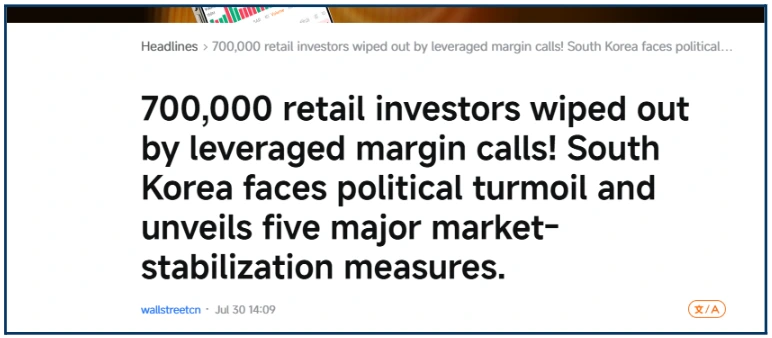
Source: WallstreetCN
When expectations run ahead of reality stocks become priced for perfection which is almost impossible to achieve.
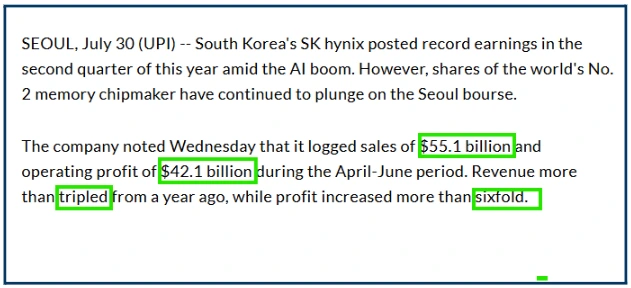
Consider these comments on SK Hynix SKHY US earnings, which were published on 29 July:
Source: UPI.com
If a 600 percent increase in profits and a 300 percent jump in revenues isn't enough to change sentiment, then you know you are in trouble.
A forced seller who marked the bottom
Source: CNBC
Ken Griffin’s Citadel ended up buying the positions from Situational Awareness.
The irony being that as they did so AI and AI related stocks rallied hard NBIS was up +27.00% by the close and added another +7.00% in the pre mkt the following day. SNDK put on +26.00% and another +4.00% in the pre market, while Micron added +18.36% and then another +3.50% before Friday's official open.
Some reports suggest that Citadel may have made as much as $3.0 billion on these trades in the space of a few hours and that's a recipe I am sure we would all like to try.
The information provided does not constitute investment research. The material has not been prepared in accordance with the legal requirements designed to promote the independence of investment research and as such is to be considered to be a marketing communication.
All information has been prepared by ActivTrades (“AT”). The information does not contain a record of AT’s prices, or an offer of or solicitation for a transaction in any financial instrument. No representation or warranty is given as to the accuracy or completeness of this information.
Any material provided does not have regard to the specific investment objective and financial situation of any person who may receive it. Past performance is not a reliable indicator of future performance. AT provides an execution-only service. Consequently, any person acting on the information provided does so at their own risk. Forecasts are not guarantees. Rates may change. Political risk is unpredictable. Central bank actions may vary. Platforms’ tools do not guarantee success.