
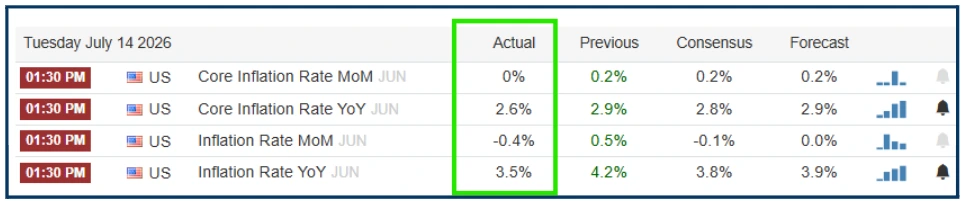
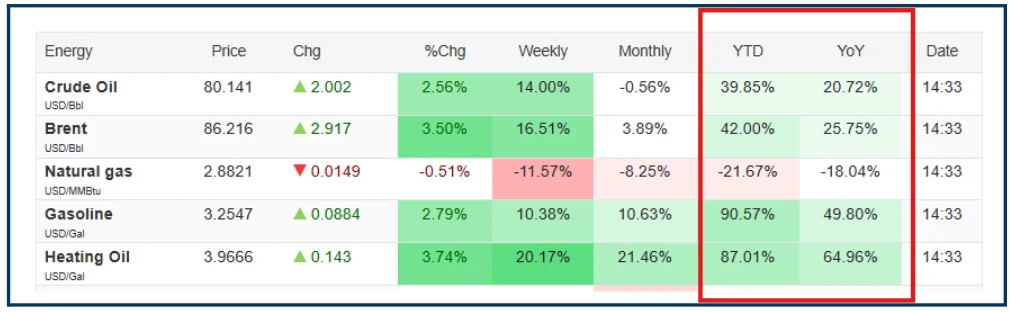
Sometimes, you see a macro data release and can’t quite believe your eyes, and the US inflation data for June was one such case. Energy prices in the US have been sky high for much of the last quarter. In fact, if we look at the third graphic below, we can see that with the exception of Natural Gas, US energy prices have been higher Year to Date.
Against that background, it seems unlikely that inflation would fall and even turn negative, which is what happened to the month over month data in this release.
The inflation data
Source: Trading Economics
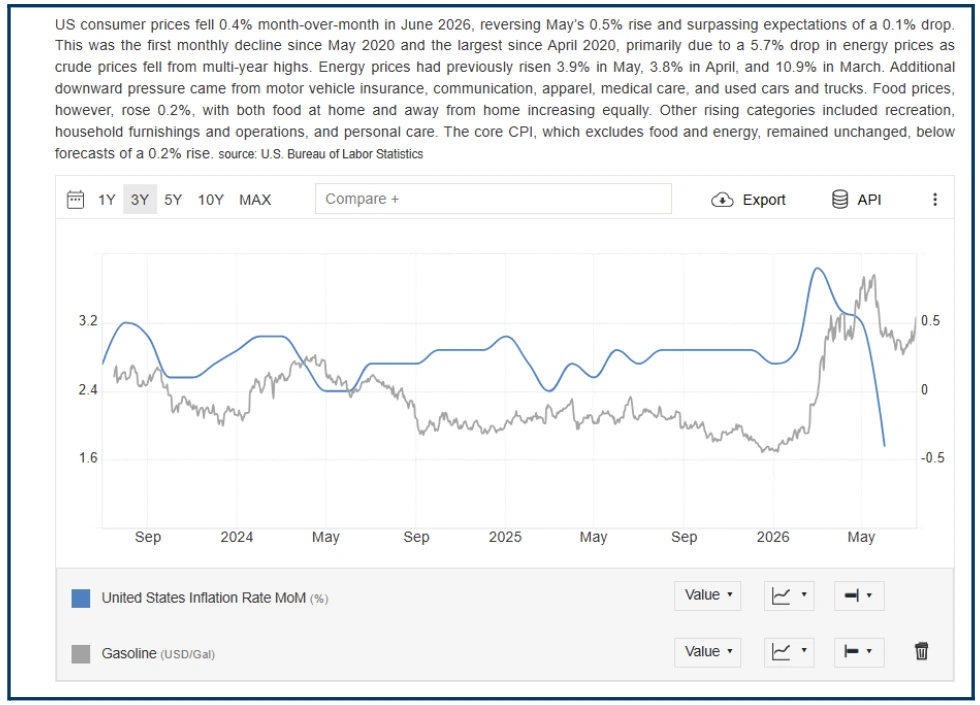
US Inflation month on month versus gasoline prices.
Source: Trading Economics
Energy Price Changes
Source: Trading Economics
How is it possible for inflation to fall in these circumstances?
Gasoline prices have been one of the most visible inflation signals over the last 25 years, but their relationship with inflation is rather uneven. Fuel price spikes often feed directly into consumer inflation expectations and can quickly shape sentiment. However, their impact on headline inflation is usually smaller and less persistent than headlines and price data suggest.
For markets, the most important channel is not the petrol station receipt itself but the way it affects behaviour. Higher fuel costs can raise near-term inflation expectations, erode consumer confidence, and impact interest rate expectations, as investors reassess whether inflationary pressures are spreading across the wider economy.
That’s why energy-driven inflation often moves Treasury yields, FX, and rate-sensitive equities before the broader CPI data catches up.
There is also a key difference between headline inflation and the underlying inflation trend.
Gasoline or petrol is a volatile component of the CPI basket, so it can push the inflation rate up or down in the short run without necessarily changing the longer-term trajectory.
Core inflation, wages, shelter, and services usually do more of the heavy lifting over time, while gasoline acts more like a catalyst for short-term market narrative. Bear in mind that core inflation excludes energy prices from its calculations.
For traders and investors, the takeaway is to treat the gasoline price as a high-frequency indicator, rather than a forecasting tool.
When fuel prices rise sharply, the first question is whether the move is feeding into inflation expectations or if it’s simply a temporary shock whose impact ultimately fades from the data.
That distinction matters because markets tend to react differently to a one-off spikes than to broad inflationary impulses.
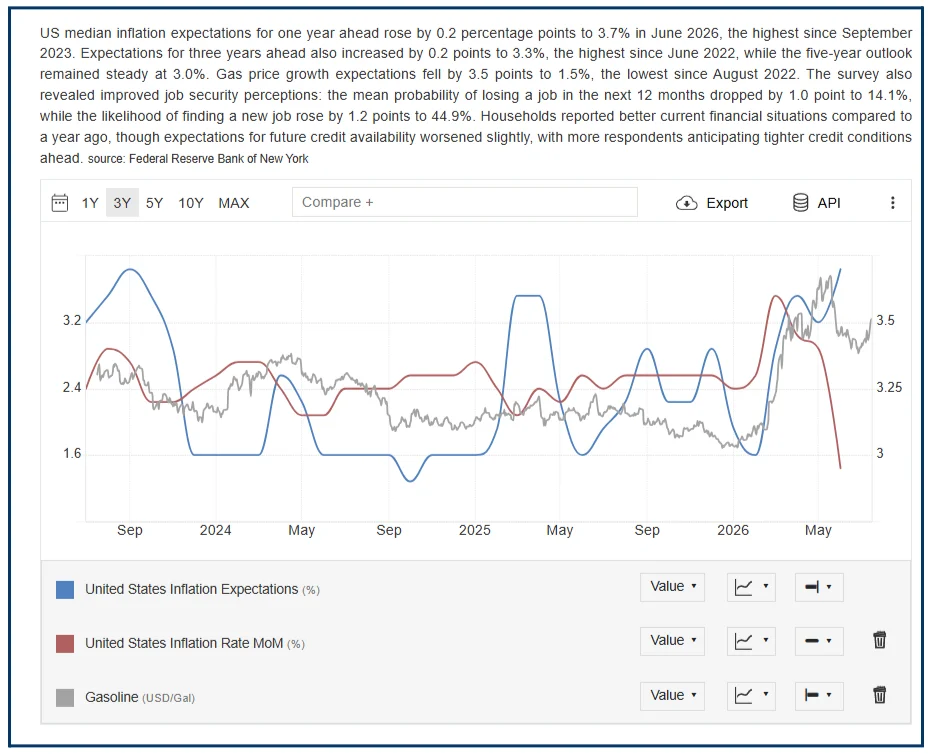
Gasoline prices seem important to us in the context of inflation because they are highly visible, immediate, and emotive. However, since 2000, their relationship with inflation has been strongest as a driver of inflation expectations and market sentiment, and not as a reliable one-to-one predictor of inflation trends.
In fact, you can get a real sense of these relationships in the chart below, which plots gasoline prices (grey) against US inflation expectations (blue) and inflation rates month over month (red)
Source: Trading Economics
Traders need a split personality
One of the hardest things to do as a trader is to separate your personal experiences from macro data and market sentiment. I am not going to pretend that the cost of living hasn’t been rising and indeed continues to rise, particularly in areas such as food, energy and the cost of accommodation.
It's just that the market doesn't always focus on these; instead, it looks at changes in the official inflation data, which don't necessarily reflect our lived experience.
The other thing to bear in mind is that our impression of rising prices is often baked in, with earlier price rises informing our opinion, rather than the marginal changes that the inflation data tries to capture.
It’s also true that each consumer has a unique rate of inflation that's personal to them, their circumstances and spending choices
I think the current methods for collecting data and calculating inflation are inadequate and in need of an overhaul. In this age of 24/7 connectivity and AI, it should be possible to have near real-time measures of key data, and whilst that capability may be beyond government departments and their statisticians, the private sector will surely offer something along these lines in the near future, if indeed they don't already do so.
To round off this article here is a table that highlights the S&P 500 sectors' relationship with the inflation data which should act a ready reckoner for future inflation data releases.
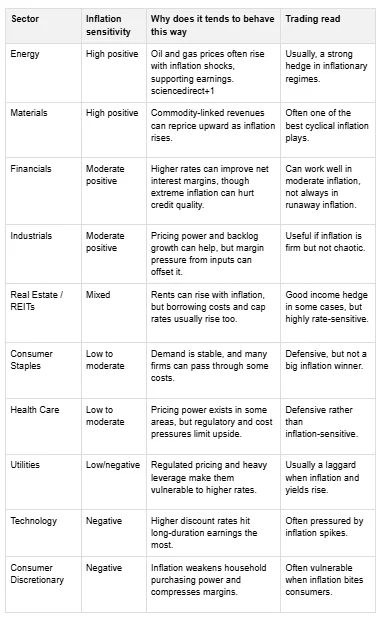
Source: Perplexity
The information provided does not constitute investment research. The material has not been prepared in accordance with the legal requirements designed to promote the independence of investment research and as such is to be considered to be a marketing communication.
All information has been prepared by ActivTrades (“AT”). The information does not contain a record of AT’s prices, or an offer of or solicitation for a transaction in any financial instrument. No representation or warranty is given as to the accuracy or completeness of this information.
Any material provided does not have regard to the specific investment objective and financial situation of any person who may receive it. Past performance is not a reliable indicator of future performance. AT provides an execution-only service. Consequently, any person acting on the information provided does so at their own risk. Forecasts are not guarantees. Rates may change. Political risk is unpredictable. Central bank actions may vary. Platforms’ tools do not guarantee success.