
Why Earnings Season Matters
For now, at least, US-listed companies report their earnings every quarter, which means that there are 4-periods each year in which investors and traders can judge the performance of the companies they are involved in.
Wall Street and its workflows revolve around this quarterly reporting cycle.
I have frequently discussed the impact of new information on market performance, price action, and sentiment, and earnings season is the period in which the market receives the most new information from the listed companies within it.
Expectations among market participants are at their highest levels in the run-up to, and during earnings, which can lead to a febrile atmosphere and heightened volatility, that is often characterised by outsized stock price moves on good and bad news.
The combination of volatility, surprises, and shifting investor expectations creates additional opportunities and risks for traders. Successful traders are often judged on their ability to manage those two yardsticks.
Indeed, some people only trade during earnings season, using the off or closed periods in between to do research and formulate their opinions and trading strategies.
The goal for these traders is not to guess the outcome of every earnings result but rather to identify situations and set-ups with a favourable risk-reward profile.
Slanting the odds of a trade's success in your favour is what a trader should be doing day to day, but it takes on extra importance during earnings season, because the consequences of being wrong can be much greater.
What would an attractive earnings season trade look like?
First of all, what it wouldn’t look like is a punt on whether a company will please or disappoint the market, because that's far too binary to make sense from a risk-reward perspective.
Instead, it would be a trade idea based on a combination of factors, such as fundamentals, sentiment and price action, with the majority, if not all, of these factors pointing towards a positive outcome.
Some traders favour taking a position ahead of an earnings announcement, others prefer to wait and jump in once the news is out, or soon after.
I wouldn't consider either approach to be better than the other.
However, I think it's fair to say you take more risk if you trade before the earnings report; against that, you have a higher opportunity cost if you trade after the news is out.
A beat doesn’t always equal a bounce
Don’t be fooled into thinking that an earnings or revenue beat will automatically mean a company's stock price will go higher or lower, because what also matters is the size of the beat, or if you prefer, the degree of surprise in the report.
We also need to remember that stock markets are forward-looking and, as such, they are pricing 3 to 6 months into the future. Markets also favour consistency and continuity, all of which means that the guidance that accompanies an earnings report can be the most influential component of it.
How can we gauge the degree of surprise or the likelihood of an earnings beat?
Luckily for us, there is an established framework for this.
Wall Street brokers and banks employ a small army of analysts whose job it is to research and get to know the stocks under their coverage. They talk to management, customers, suppliers, and competitors of the business. Analyse the stock's financial records and how other companies in the sector are valued and performing.
Ultimately, they form an opinion about the company and an estimate for the earnings and revenues it's likely to produce, as well as price target for the stock.
Mid and large-cap equities in the US have numerous analysts researching their stock, which, of course, means numerous earnings estimates that are published and consolidated to form what's known as the consensus (or average) forecast.
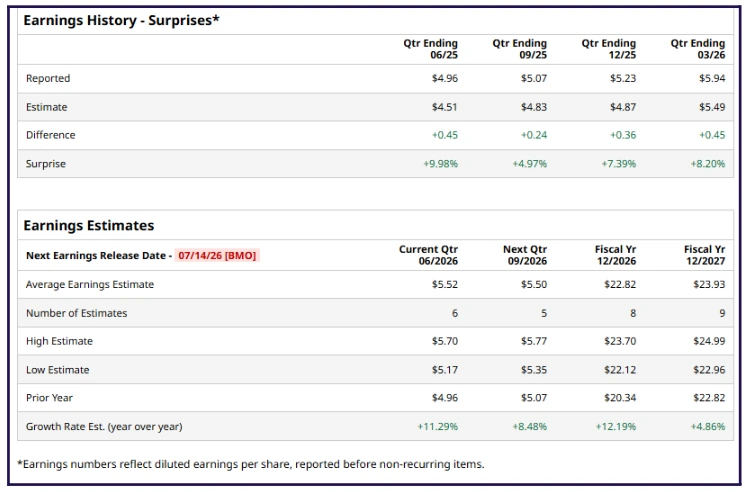
We can see the consensus forecast for JP Morgan JPM US below.
We see earnings estimates out to the end of 2027, in the lower part of the table, but also some earnings history or background in the upper part of the table. This includes the degree of surprise in those earnings.
Source: Barchart.com
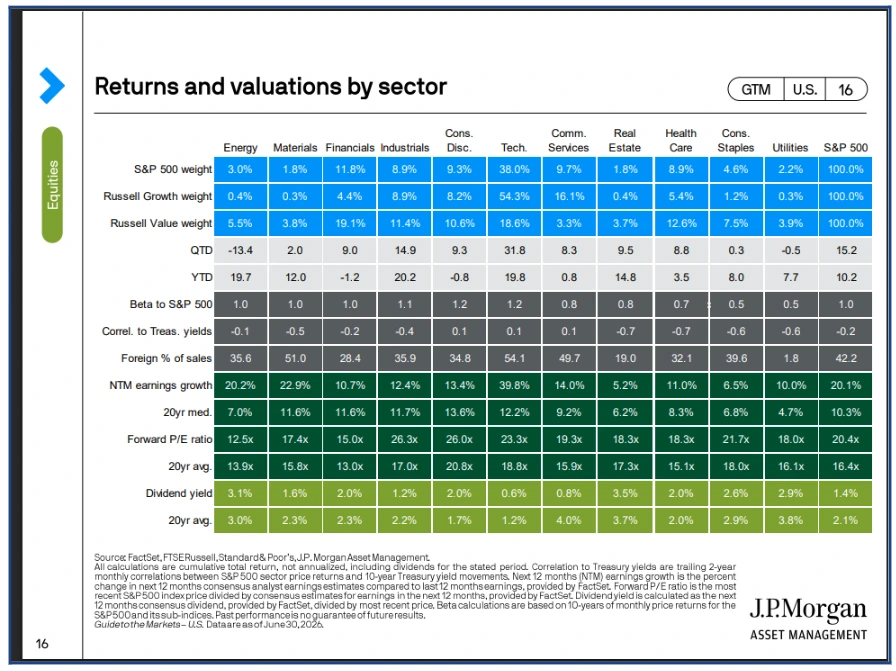
When you are looking for earnings season trade ideas, it's useful to have a ready reckoner, something that provides you with an at-a-glance handle of the markets. This table, which comes from JP Morgan Asset Management’s Guide to the Markets, does the job for the S&P 500 index. (This guide is freely available online)
It's laden with useful information, for example, the row titled NTM earnings growth shows us what the market is expecting in earnings growth by sector, over the Next Twelve Months.
Source: JPM AM Guide to the Markets
The Energy, Materials and Technology sectors are all forecast to deliver significant earnings growth in that period, and even relative laggards like Real Estate and Consumer Staples are expected to produce growth numbers ahead of current inflation rates in the US.
The data contained in a table like this can be used to find trade opportunities over earnings season, and in the second part of this article, we will try to do just that.
The information provided does not constitute investment research. The material has not been prepared in accordance with the legal requirements designed to promote the independence of investment research and as such is to be considered to be a marketing communication.
All information has been prepared by ActivTrades (“AT”). The information does not contain a record of AT’s prices, or an offer of or solicitation for a transaction in any financial instrument. No representation or warranty is given as to the accuracy or completeness of this information.
Any material provided does not have regard to the specific investment objective and financial situation of any person who may receive it. Past performance is not a reliable indicator of future performance. AT provides an execution-only service. Consequently, any person acting on the information provided does so at their own risk.