The US equity market has been irrational for 6 weeks or more, and while it’s behaving that way, it becomes almost impossible to trade with any degree of confidence, or sensible risk management.
At times like this, it's often best to take a step back and remind ourselves about the basics or fundamentals of trading, and that's what this article is all about.
What Is an Equity, Really?
When someone buys a share of a company, what exactly are they buying?
The word "equity" gets used constantly in financial media, but its actual meaning is worth reflecting on, because it shapes many other concepts in investing/ trading.
An equity or share is a unit of ownership in a company. Buy one share in a business and you own a proportional slice of everything that company is and does.
A share is not a receipt for money lent to that company. That distinction matters more than it sounds.
A bondholder lends the company money and expects a fixed schedule of interest payments, plus the return of principal on maturity of the loan.
A shareholder has no such privileges. There is no guarantee of a payout, no maturity date on their exposure, and no fixed return.
What a shareholder has instead is a residual claim: a right to whatever is left over after the company has paid its debts, its suppliers and its employees.
That is why shareholders sit at the back of the queue if a company fails, and why they can also capture unlimited upside if it thrives. Ownership and participation, not lending, is the deal.
This already tells you something important: equity value is not really about counting up what a company currently has.
It is tempting to think a stock's price should roughly track the sum of its assets, cash and intellectual property, as if adding up line items on a balance sheet would equate to its current value.
In practice, share prices rarely work that way.
A company's market value is usually a long way from its net tangible assets, sometimes many multiples above it.
The difference between a stock's market cap and the value of the company’s assets can be found in the market's perception of the business: everything that investors believe the company is worth today and will become in future, none of which appears anywhere in the balance sheet (most of the time).
That gap has a name in accounting, and it’s goodwill. This is the premium paid above a company's net tangible worth, and it is a bet on things that are real, but hard to measure.
Brand equity is the most obvious example: the recognition and trust that a company has built up over the years, which a competitor cannot simply replicate by spending money.
Customer loyalty is another, repeat buyers and pricing power that can outlast any single product cycle.
Reputation also matters: how a company is perceived by its customers, employees and the wider market.
Most important of all are the market expectations around future growth and earnings in that business.
None of these items shows up in a balance sheet, yet they represent a significant chunk of what a company is valued at.
So what moves the market's perception of a business and therefore its share price?
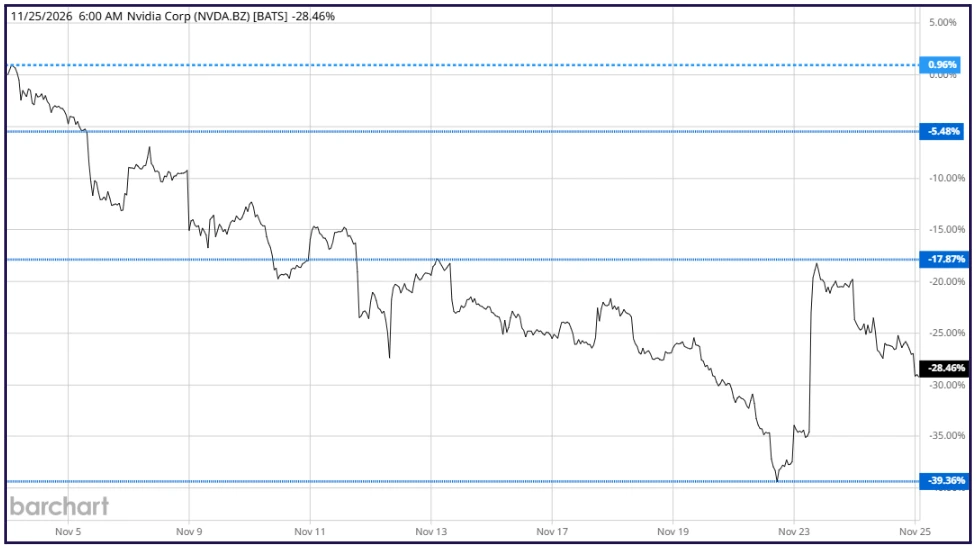
A 15-day percentage price change chart of Nvidia (NVDA, US) shows a 40.0% swing in the value of one of the world's biggest companies.
Source: Barchart.com
Three things tend to dominate.:
The first is future earnings: the market is constantly pricing in expected profit growth over the years ahead, not just the trailing twelve months behind. When we say the markets are forward-looking, this is what we mean.
The second driver is market sentiment, the prevailing level of confidence, momentum and appetite for risk, which can swing valuations, even when the underlying business has not changed much. See the NVDA chart above.
The third is competitive moat: the durable advantages, brand strength, network effects and pricing power that let a company defend its earnings against competitors who are trying to erode them.
In other words, equity ownership is forward-looking. It is a bet on a trajectory and confidence, not just a snapshot of a balance sheet.
A real-world example
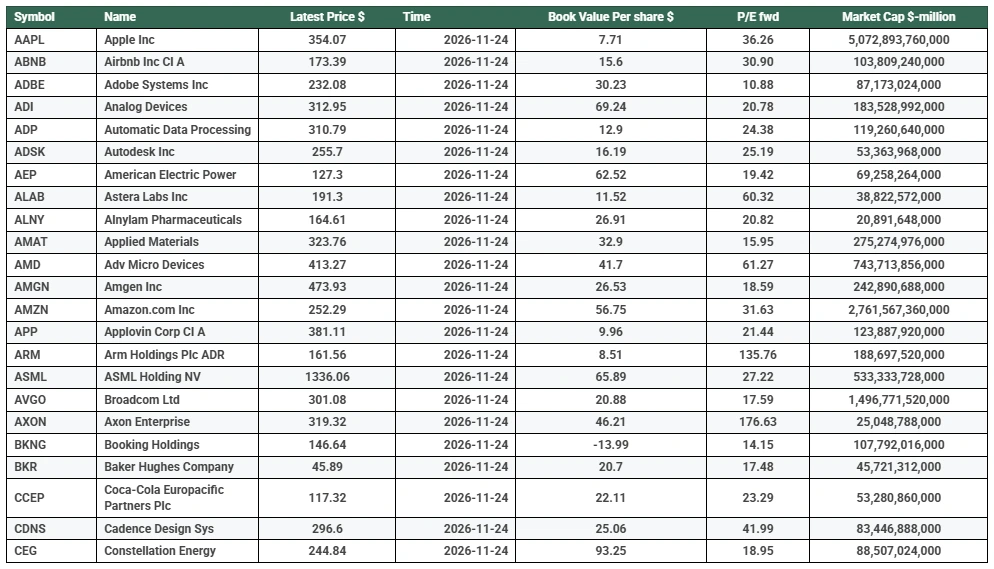
This table shows a selection of Nasdaq 100 stocks: we can see the last price they traded at, the book value per share (the per-share value of the company, over the last 12 months) and the PE or Price-to-Earnings, ratio that traders are currently prepared to pay to own that stock.
When you see that the book value per share of Apple is just $7.71 but it last traded at just over $354.0 I think you can grasp what I am talking about in this article.
Source: Barchart.com/Darren Sinden
It’s worth comparing stocks with other assets to see how unusual equity really is.
A bond is a loan: its return is a fixed or floating rate interest payment over its lifetime, its risk is lower because it is contractual, and its value is anchored to its face value and the coupon, or interest rates the bond pays.
Cash is a deposit: usually it carries a fixed and low rate of return, it has the lowest risk i n the pyramid of assets, and a valuation that never moves above its face value. However, the spending power of cash can be quickly eroded by high and persistent inflation.
Equities sit at the opposite end of the spectrum on every one of these characteristics: They offer partial ownership, a variable, uncapped and uncertain return. So that’s higher risk with no guarantees, and a value that is often largely built around a perceived future worth, rather than anything that’s fixed in a contract.
That is really the core idea to take away. Equity valuation is a belief about the future. It is calculated from expected earnings, expected growth and market confidence. Not simply from what is sitting on the balance sheet today.
Understanding that is the basis for almost everything that follows in equity analysis, from the valuation ratios investors use to compare companies, to the sector classifications that let you benchmark one business against its peer. To the trading concepts, such as relative value and mean reversion, that try to identify when the market's belief has drifted too far from what the fundamental data can support.
Each of these concepts is built from the same starting point: a share price is a claim on a company's future, not a receipt for its past.
If we are trading CFDs on stocks, we don’t enjoy ownership of the underlying shares. Instead, we have an economic interest in the rise and fall of the stock price. But those stock price moves are often influenced by these basic concepts.
The information provided does not constitute investment research. The material has not been prepared in accordance with the legal requirements designed to promote the independence of investment research and as such is to be considered to be a marketing communication.
All information has been prepared by ActivTrades (“AT”). The information does not contain a record of AT’s prices, or an offer of or solicitation for a transaction in any financial instrument. No representation or warranty is given as to the accuracy or completeness of this information.
Any material provided does not have regard to the specific investment objective and financial situation of any person who may receive it. Past performance is not a reliable indicator of future performance. AT provides an execution-only service. Consequently, any person acting on the information provided does so at their own risk. Forecasts are not guarantees. Rates may change. Political risk is unpredictable. Central bank actions may vary. Platforms’ tools do not guarantee success.