
The war in Iran is putting a strain on the global economy, because so much of the world's energy infrastructure is situated in the Persian Gulf and a large percentage of crude oil, liquid natural gas (LNG) and other petrochemicals, pass through the narrow waterways of the region on tankers bound for the Americas, Europe and Asia.
On Wednesday LNG suppliers, including Shell, declared “ force majeure" on contracts emanating from Qatar, which had earlier closed its LNG processing plants. Plants that account for as much as 20.0% of the world's LNG processing.
That move voids deals that were already struck, leaving the buyers to try to fill their needs in other markets.
The CEO of the world's largest oil company, Saudi Aramco, has warned of catastrophic consequences if the war and the oil crisis it has created. continue.
Aramco CEO, Amin Nasser, said that:
“ The disruption has caused a severe chain reaction in not only shipping and insurance, but there's also a drastic domino effect on aviation, agriculture, automotive, and other industries," Nasser said. "There would be catastrophic consequences for the world's oil markets the longer the disruption goes on, and the more drastic the consequences for the global economy."
Oil storage capacity in the Gulf states is running out, and if it does, then producers may have to stop pumping oil altogether. As there will be nowhere for their oil to go, once it's out of the ground.
In peacetime, some 15.0 million barrels of crude leave the Gulf in tankers (passing through the Straits of Hormuz) every day. Whereas it is estimated that only 2.0 million bopd exit the region via pipelines.
Targeting tankers
Iran has started attacking vessels in the straits of Hormuz, with several ships now abandoned and on fire in the narrow waterway, creating additional hazards to shipping.
The prolonged closure of the sealanes in the Persian Gulf could remove as much as -15.0% of daily crude oil production from the global economy, and as much as -20.0% of global LNG production as well.
Energy markets have reacted accordingly.
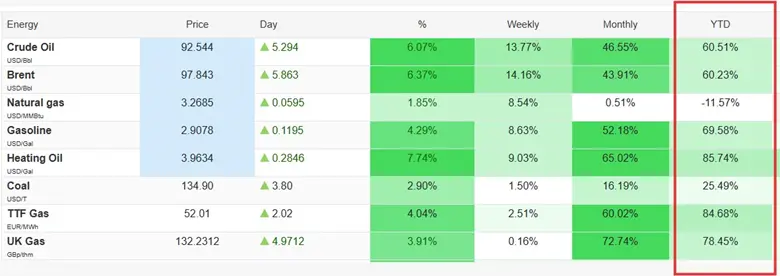
The year to date change column, on the far right, of the table below, shows what’s been happening to energy prices in 2026. And whilst some of them,maybe off of their peaks. They all remain elevated, and have the potential to move higher still.
Selected Energy prices and their recent percentage changes
Source: Trading Economics
Oil and gas are the most obvious areas to be affected, but what other markets are sensitive to current events in the Middle East?
One that might surprise you is aluminium
A substantial proportion of the world's aluminium production happens in the gulf.
Major players that have plants there, including Norsk Hydro and ALBA (Aluminium Bahrain) have declared force majeure, and have stopped shipping aluminium from the gulf.
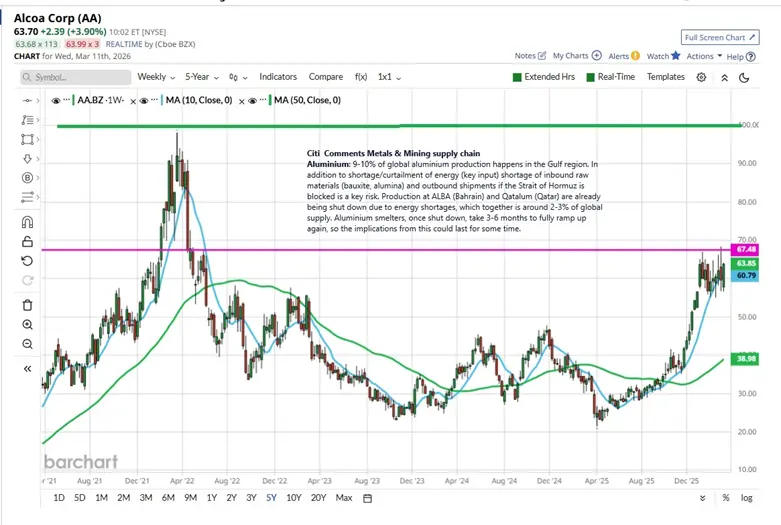
Some 5.0 million metric tonnes of aluminium are shipped through the gulf each year, as Citi bank analysts noted in a research note published yesterday (11/03/26).
That equates to approximately 3.0% of global production being withdrawn from the market.
What’s more, once aluminium smelters are shut down, and have gone cool, it can take between 3 and 6-months to get them operational again.
I have highlighted Alcoa AA US (a leader in the mining, refining and production of aluminium products) in the chart below and annotated it with some of Citi’s comments.
Alcoa closed up by +8.24% on Wednesday at $66.36.
In Europe, Norsk Hydro NHY has added more than +7.0% to its share price over the last two days.
Meanwhile aluminium futures have risen by between +10.50% and +14.0% over the last month depending on the contract.
Source: Barchart.com/Citi Research
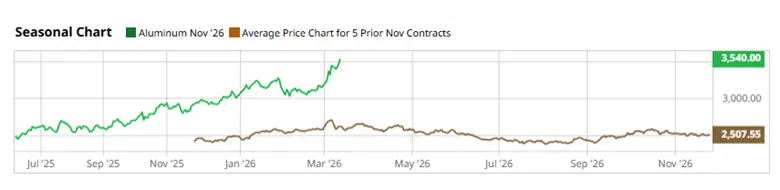
Looking out to November 2026 futures, aluminium is trading about -13.0% below its10 year highs.
If we look at a seasonal chart for the November 26 contract (see below).,which compares the current November contract (green line), against the 5 previous November contracts.
We can see that its trading at prices that are well above average, and that the price of the current contract, is trending higher.
Source: Barchart.com
However we need to bear in mind that Alcoa has risen by just over +100.0% in the last 6 months. And so its stock price may already reflect, or be factoring in, the squeeze on aluminium markets brought about by the Iran war.
Food for thought
Another sector of the market that could be directly affected by the conflict, and the rising price of energy is food and food production.
The reason for the correlation between food and energy is quite straightforward.
Modern fertilisers, that help to boost crop yields, are made from petrochemicals.
The higher energy prices go the higher the cost of fertilisers, and the higher the cost of producing food becomes.
Increased costs, which are likely to be passed on, to the end consumer.That's the kind of thing that can create sticky or stubborn inflation.
In fact Simon White, a macro strategist at Bloomberg, pointed out in a recent post, that the contribution from food inflation to CPI in 1973 was twice as much as that made by oil.
1973 was the year in which OPEC imposed an embargo on western nations, who were supporting Israel in the Yom Kippur war.
Simon White also flagged that following the Iranian revolution, in 1979.Food inflation contributed as much as energy to the jump in US CPI.
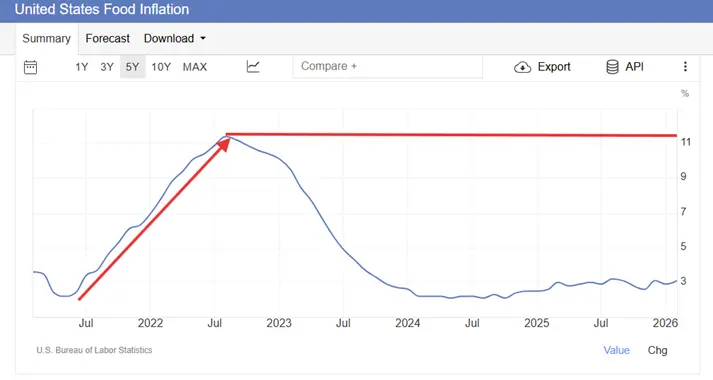
The jump in fertiliser prices that came about because of the war in Ukraine, and the sanctions levied against Russia, was a major factor behind the food inflation seen in the US, in 2021/22.
US food inflation hit 11.0%
Source: Trading Economics
The possibility of further long lasting energy and food price shocks, is one of the reasons that some people are talking about “Stagflation” again. Something we will look at in more detail in a future article.
For now though I want to concentrate on Mosaic MOS US a US listed producer of phosphates, potash and other chemicals, used in agriculture. Mosaic is one of the leading manufacturers and distributors of these products globally ,with annual sales just over $12.0 billion.
As you can see Mosaic stock jumped by +10.0% on the 11th of March and added another +5.49% in after hours trading.
Year to date Mosaic’s stock price is up +27.20%. However, over 6-months its down by almost -9.0%.
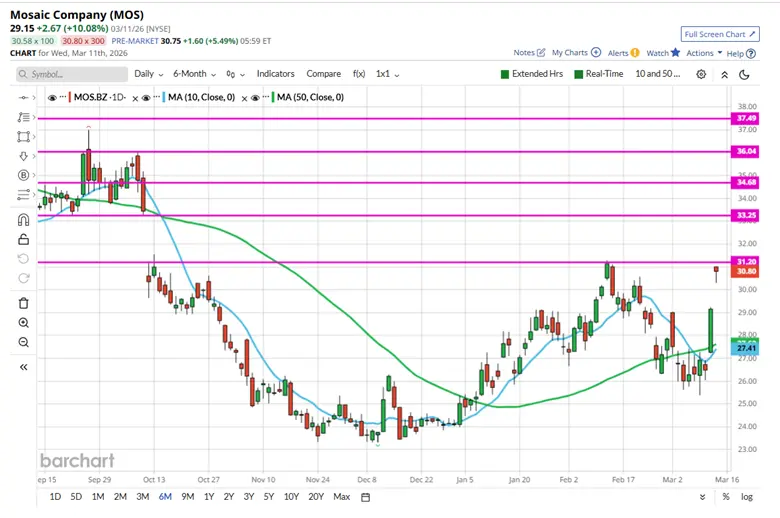
Source: Barchart.com
Correlation is not the same as causation
Yet look at a 5-year chart of Mosaic, overlaid with the price of spot US crude oil (WTI). See below.
It’s pretty clear that where one leads, the other tends to follow. It also appears that Mosaic’s stock price, has lagged the recent gains seen in crude oil.
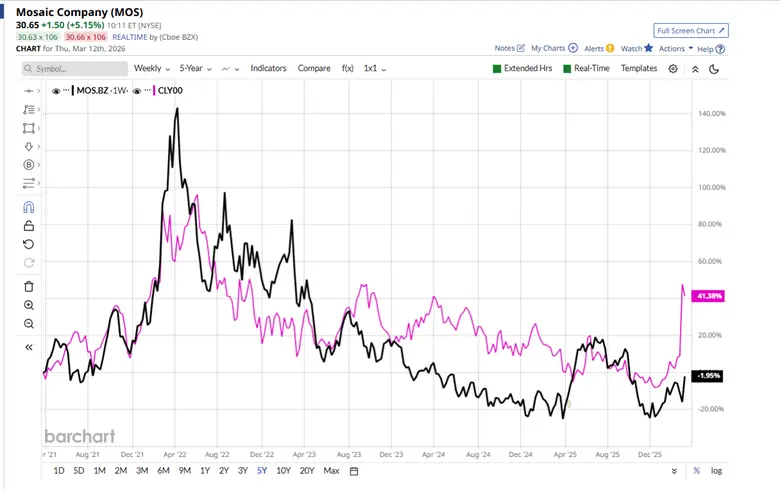
Source: Barchart.com
There are many other commodities and raw materials that are likely to be affected by a prolonged conflict.
They inclide sulphur and sulpuric acid, which are essential for the extraction of copper, and helium which is used in the manufacture of silicon chips.
South Korea, a leading manufacturer of memory chips, imports around 60.0% of its helium from the Persian Gulf. Memory chips are an essential component of the AI processors made by the likes of Nvidia NVDA US and AMD AMD US processors that are the heart of modern data centres.
The information provided does not constitute investment research. The material has not been prepared in accordance with the legal requirements designed to promote the independence of investment research and as such is to be considered to be a marketing communication.
All information has been prepared by ActivTrades (“AT”). The information does not contain a record of AT’s prices, or an offer of or solicitation for a transaction in any financial instrument. No representation or warranty is given as to the accuracy or completeness of this information.
Any material provided does not have regard to the specific investment objective and financial situation of any person who may receive it. Past performance is not a reliable indicator of future performance. AT provides an execution-only service. Consequently, any person acting on the information provided does so at their own risk. Forecasts are not guarantees. Rates may change. Political risk is unpredictable. Central bank actions may vary. Platforms’ tools do not guarantee success.